
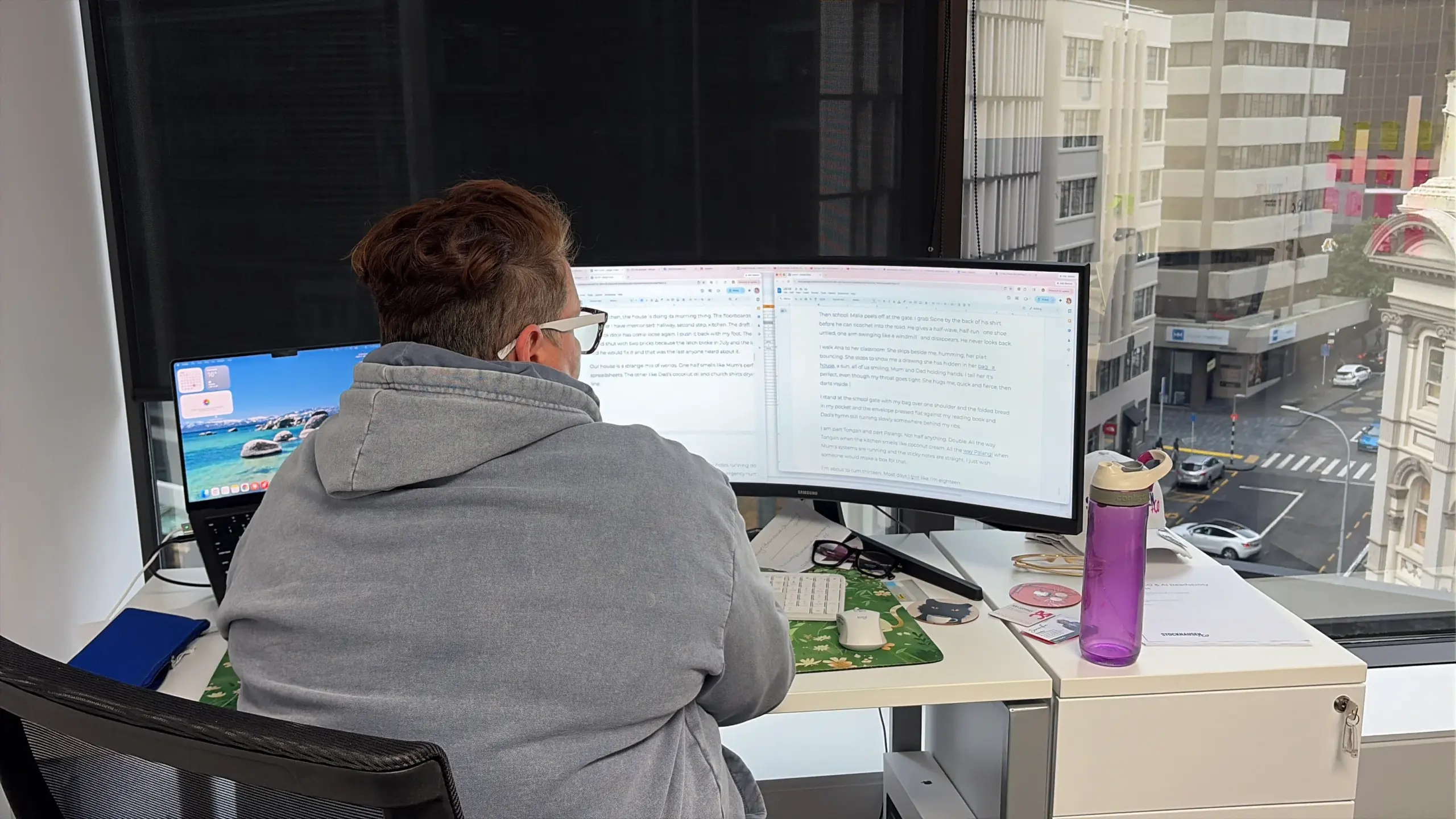
I am not a writer. I have said that so many times and I genuinely believe it. But here I am, two years deep into a story that will not leave me alone.
I have always loved books. Adventure stories, the kind that pull you in and do not let you go. But I look at my daughter growing up part-Tongan in New Zealand and I think about what is going to be on the shelves for her. We all want to see ourselves in stories. And I think we need more books out there that reflect real life a little – real families, real cultures, real kids navigating worlds that actually look like theirs.
We had been building our house in Tonga during COVID without being able to be there. When the borders finally opened and we got back, something shifted. I was welcomed into my husband’s very large family for the first time and I fell in love with the island, the people, the way life just moves differently there.
Then I started dreaming about a story. Every morning that June, I would sit on the deck with my coffee and more of it would come to me. A girl. A family full of secrets. A silence that everyone agreed to keep. I would sit there watching the plantation and the animals and these characters would just arrive, like they had been waiting for me to slow down enough to hear them.
So I started writing it down. Not because I thought I could write a book. I just could not stop the story from coming.
Two years later, I am working on my final draft. I have spent days working out the family tree, mapping the lines, the history, the weight of what gets passed down when no one talks about it. This story lives somewhere between two worlds, and it has been one of the most personal things I have ever done.
The Malohi Line: The Silence We Carry is a middle-grade novel for 8 to 12 year olds and it is Book One of a trilogy.
Everyone in Lisi’s family has a secret. She just does not know it yet.
What she knows is this: Mum hides letters she will not open. Dad hides something in the garage he will not touch. And somewhere across the ocean, a grandmother keeps calling with the same words every week.
Lisi is twelve and she sees everything. She counts what others ignore. She reads faces the way other kids read books. She notices the things that do not add up, the gaps in stories, the words that stop mid-sentence, the silences that are louder than arguments.
Because secrets have weight. And in this family, the silence is starting to crack.
When everything unravels, Lisi finds herself holding a pendant carved with a symbol she has never seen before, connected to a truth that has been buried longer than she has been alive.
The adults chose silence. Lisi chooses answers.
